







Transcribing call recordings: accuracy and cost on phone audio
Eight transcription setups on 8 kHz call audio in English, Spanish and Hindi. Error rates, cost per minute, speed, and where speaker labels went wrong.
To the point
On clean English and Spanish phone audio, the transcription engines we tried were close on word accuracy. They differed on speaker labels, speed, price and Hindi. Choose on those, and test on your own recordings.
- Word error was 0.6% to 4.9% in English and Spanish across eight setups, a handful of words per call.
- Speaker labels failed on mono audio: 2 of 15 files came back with one speaker on the cheapest setup.
- Stereo files, one speaker per channel, gave exact speaker attribution on 15 of 15.
- Cost ran from $0.0027 to $0.024 per audio minute, and from 0.3 s to 25 s per call.
How we tested
We wanted to pick engines for transcribing recordings from VICIdial servers. The test set was 15 scripted two-speaker calls: sales, collections and support. Six were English, six Spanish, three Hindi, 1,251 seconds in all.
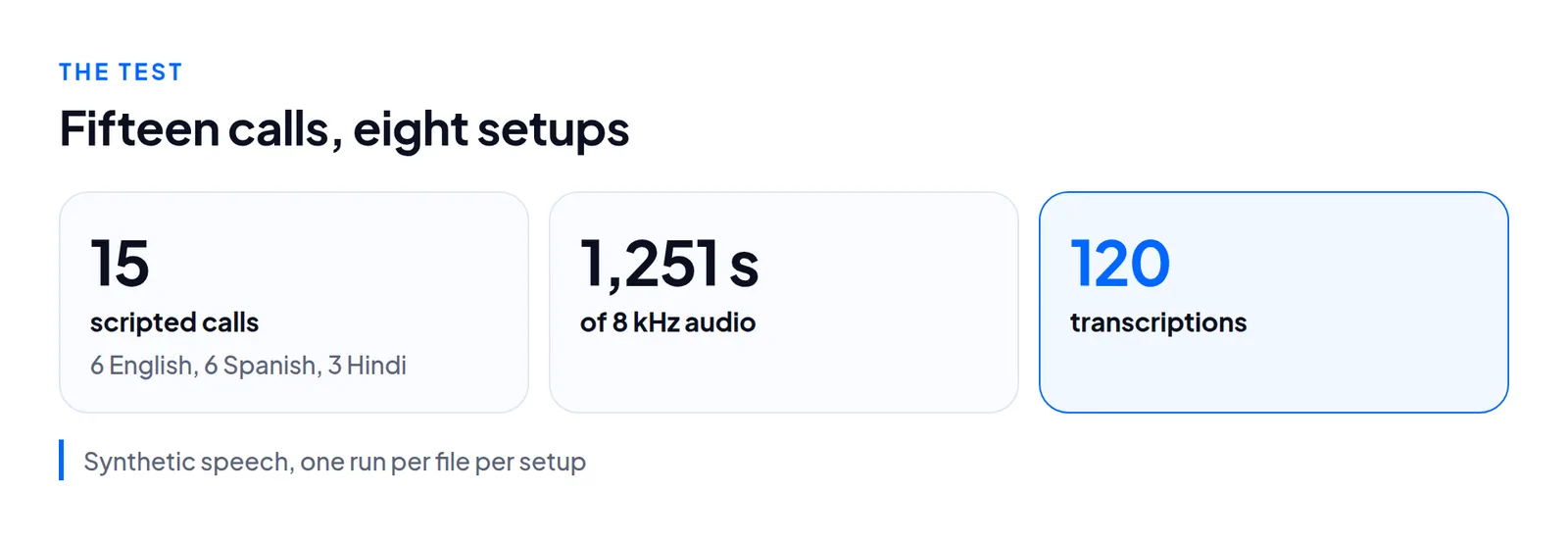
The speech was synthetic. We converted it to 8 kHz mu-law, once as mixed mono and once as stereo with one speaker per channel. We scored word error rate (WER) for English and Spanish, and character error rate (CER) for Hindi. Each setup ran once per file, on one day in October 2026.
What it cost
Prices are as we read them that day. Deepgram is its published pay-as-you-go rate. The Azure figure assumes $0.36 per audio hour and we have not checked it against an invoice. The three gpt-4o models ran through Azure, billed by token.
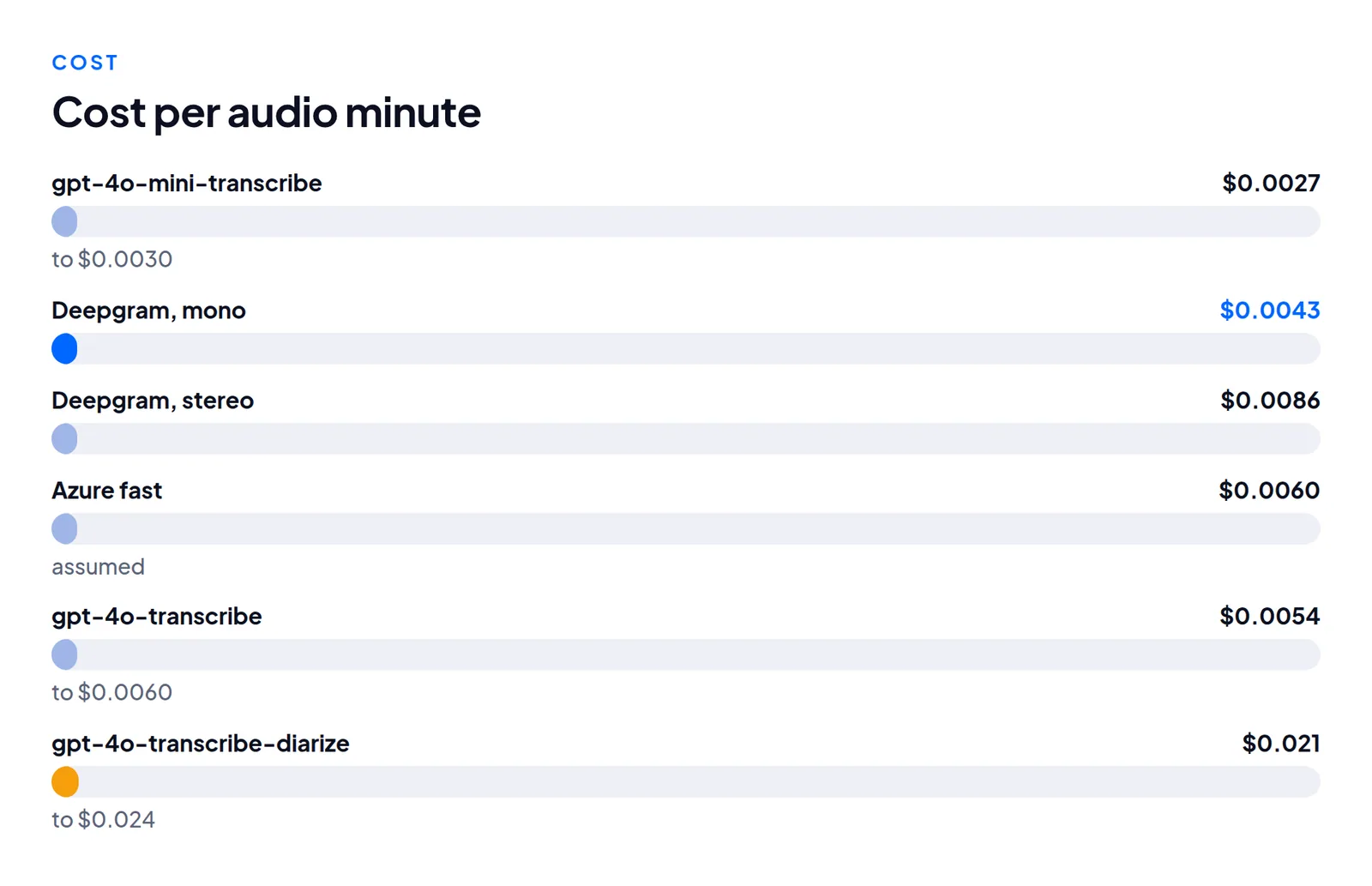
At $0.0043 a minute, 10,000 hours of recordings costs about $2,600. At $0.023 it costs about $13,800. The dearest setup cost over five times the fastest, took fifty times as long, and led in no language.
English and Spanish: do not choose on accuracy
The gap between 0.6% and 1.7% WER on six clean files is a handful of words. Other differences matter more.
- Speed. Half a second, against two to four seconds, against 25. A nightly batch does not care. A transcript in front of a supervisor right after the call does.
- What comes back. The two plain gpt-4o models, called our way, returned text only: no speaker labels, no word timings.
Who said what
This is the finding we would act on first. On mono audio the engine has to guess which voice is which, and it guessed wrong on whole files.
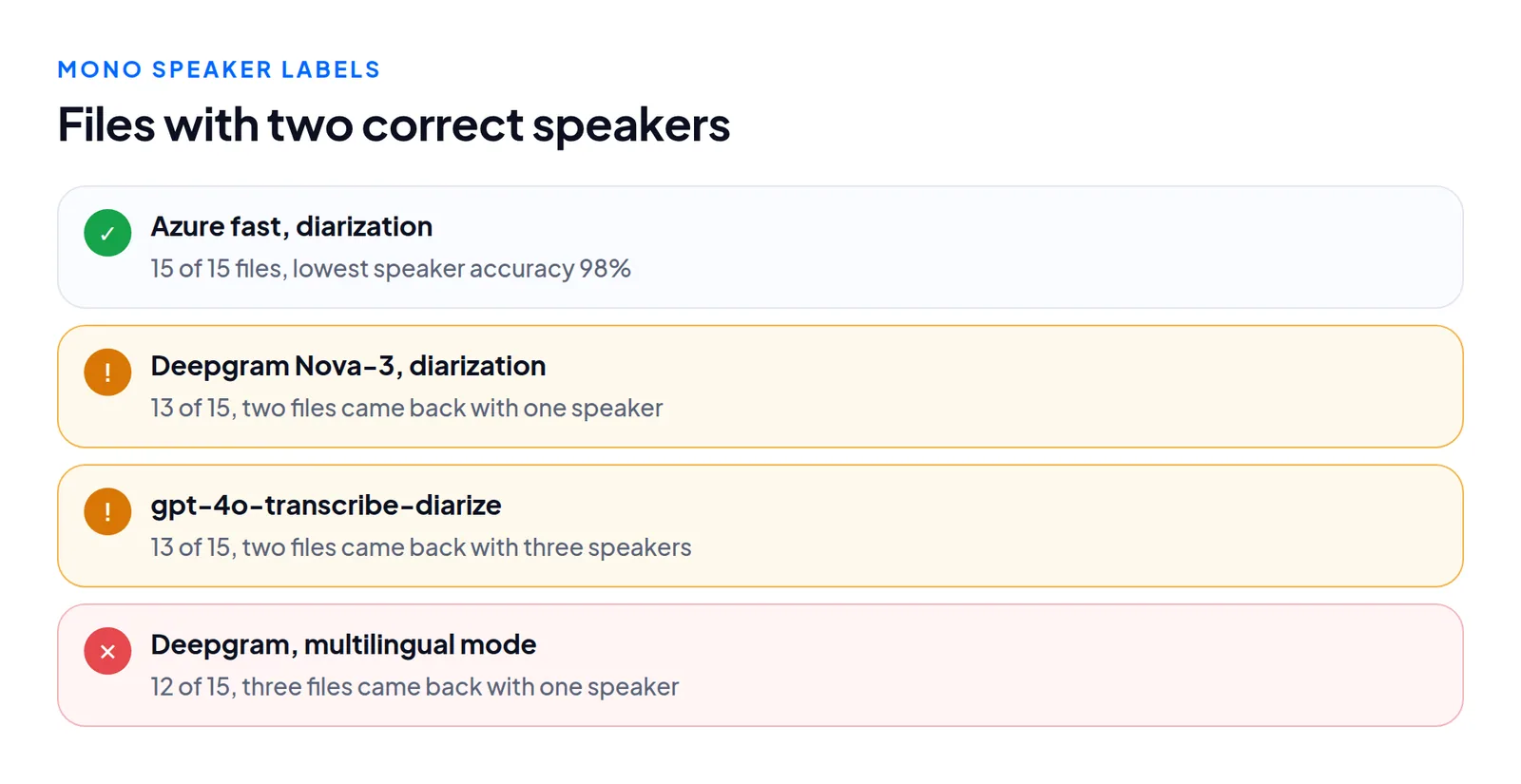
Every failure was on the collections script. The words were right, but on the one-speaker files the whole call was credited to one person. The first setup averaged 92% speaker accuracy, which hides ten good files and two unusable ones.
Stereo removes the guessing. Deepgram's documentation says of multichannel, "you will receive separate transcripts for each channel". Azure's fast transcription has a channels setting that otherwise "merges all input channels into a single channel". Both attributed speakers exactly on 15 of 15 stereo files.
Hindi
Three calls is a reason to test, not a figure to quote. Three setups scored 4% to 5% CER, one about 10%, and four about 28%.
The 28% was mostly formatting. Those engines wrote numbers as words where our reference had digits, and wrote English words inside Hindi sentences in Latin script. Both are defensible, and both defeat exact matching. Searching for 22 scripted facts as literal strings found 21 with Azure stereo, 17 with gpt-4o-transcribe, and 6 or 7 with Deepgram.
The analysis pass
We ran a small language model over all 120 transcripts for a five-item scorecard and key facts.
- Valid JSON with all five items: 120 of 120, about a tenth of a cent per call.
- Facts extracted: 49 or 50 of 50 per setup in English and Spanish, and 22 to 25 of 25 in Hindi.
- Quotes offered as evidence: 627 of 715 appeared word for word. About one in eight did not.
If you show evidence quotes to a supervisor, check each against the transcript in code first.
What we did not test
Real recordings (the big gap), calls over two minutes, other languages, volume discounts, and engines not named here.
Questions people ask
Which engine is the most accurate?
On this test no engine won on accuracy for English and Spanish. For Hindi, Azure fast transcription and gpt-4o-transcribe scored best, but on three calls.
Does transcription change what I need on the server?
Two-channel recording and transcription add load and storage, so check lines and capacity before turning them on. Audio constraints are covered in audio formats in VICIdial.
Next steps
- Check whether your recordings are mono or two-channel.
- Pull 20 real calls per language, bad ones included, and fix a machine draft by hand as your reference.
- Score speakers per file, then price your monthly hours at each rate.
To try this on your own recordings, order a hosted server and ask for two-channel recording from day one, or see VICIdial hosting.
VICIdial is a trademark of its owner. Trustane is an independent hosting provider.
Sources
Managed VICIdial hosting